

More Time for Politics: How the Mecklenburg-Western Pomerania State Parliament Completes Minutes Faster with AI Speech Recognition
How the Mecklenburg-Western Pomerania State Parliament creates its meeting minutes with Tucan.ai in minutes instead of hours

Anyone who has ever sat in the visitor galleries of a state parliament session knows: debates can be fast, heated, and colored by regional dialects. What is said in real-time later becomes part of the official record – a mandatory task that, until recently, tied up large parts of the administration in Schwerin. For every hour of speech, transcribers had to spend six to twelve hours typing, correcting, and formatting. Live subtitles for people with hearing impairments? Inadequate – the previous provider repeatedly caused technical issues.
In search of an alternative, the parliament administration came across Tucan.ai in 2022, a Berlin-based start-up specializing in AI-driven speech recognition “made in Germany.” Unlike many American solutions, Tucan.ai promises GDPR-compliant processing in German data centers and an accuracy rate that does not shy away from dialects and interjections. But do the promises match parliamentary reality?
The first test was unspectacular but promising. The IT department sent a ten-minute audio recording to the start-up. After four minutes, a raw transcript was available, in which over 90 percent of the words were correctly recognized – enough to expand the trial to full session days. For three months, manual and automatic transcription ran in parallel. During this time, editors fed the system with technical vocabulary, corrected proper names, and reconciled doubtful cases. By the end of 2023, the accuracy rates were so stable that the parliament ventured into full-scale operation.
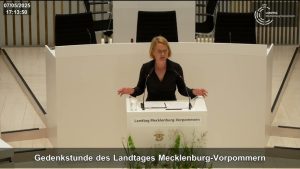
Since then, a single audio stream from the plenary hall is sufficient. Tucan.ai breaks the signal down into segments, so-called “chunks,” and stores them in a vector database. This technical trick ensures that the AI keeps track of the conversation even during abrupt topic changes and heated interjections. Within six minutes, a transcript is ready, which the editorial team checks and approves using a streamlined web editor. Today, post-processing takes only about one-fifth of the previous time. Simultaneously, live subtitles run on the hall monitors and in the public stream – a gain in accessibility that was previously only possible with significant personnel effort.
Technically, everything remains on home soil. The application runs as a single-tenant instance in a data center in Nuremberg; if required, it could also be operated completely on-premise. Thus, the project meets the strict data protection requirements of the public service without sacrificing the flexibility of a cloud solution.
It is exciting to see how quickly the learning curve of such an AI emerges. After just two plenary days, the most frequent names of members of parliament were securely anchored in the system. Legal citations, which initially appeared as a jumble of letters, were reliably recognized after a few corrections. Experience shows that missing passages are less due to the technology and more to poor microphone discipline on the podium – an insight that likely applies to other parliaments as well.
And what about the much-cited “hallucination” of large language models? Where literal reproduction is concerned, Tucan.ai plays it safe: the AI only reproduces what can be heard in the audio and marks uncertainties directly in the editor. For future additional functions – such as automatic summaries by agenda item – the parliament uses a second layer: a language model fine-tuned for parliamentary language that supports its statements with references to the original passage.
After half a year of practical operation, the results can be summarized in four sentences: One hour of speaking time ends up as raw text in the system after six minutes. Word accuracy is around 92 percent live, and 99 percent after brief correction. The minutes are published on the same day. And the administration saves up to eleven hours of manual effort per session hour – time that will flow into research, service, or simply a punctual end to the workday in the future.
The look ahead is already outlined. A search function is set to launch still in 2024, allowing members of parliament to jump across thousands of pages of plenary minutes – including a source link to the respective speech. In this way, the Mecklenburg-Western Pomerania State Parliament could show that digital transformation in parliament does not begin with big promises, but with a small, measurable step: getting the minutes finished faster. Everything else follows from the newly gained time.
Interested in a similar project? Book a free consultation call now!